A Day in the Life of a Baylor DPT Student
The Baylor Doctor of Physical Therapy program consists of three primary components:
- Didactic coursework in the virtual classroom
- Hands-on training at onsite lab immersions
- Practical application of skills through clinical experiences
Find out more about how these three components come together for an exemplary education by reading about the Baylor DPT curriculum.
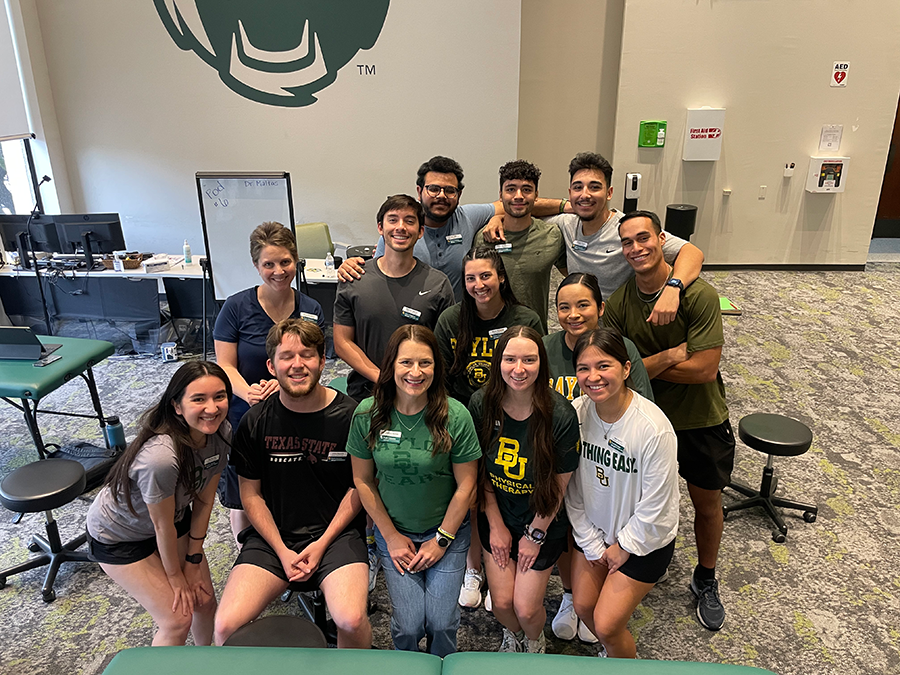
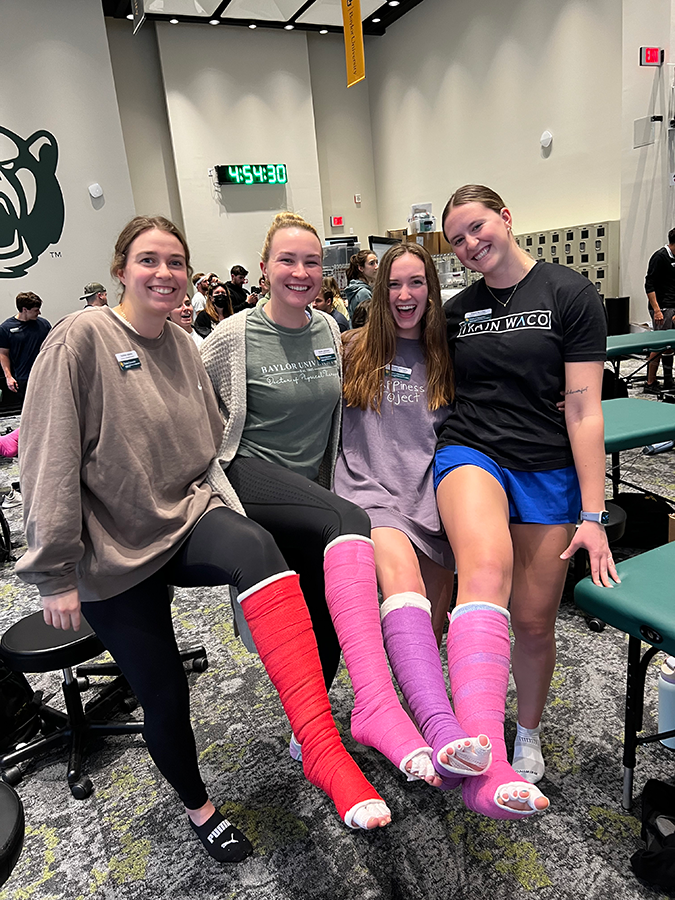
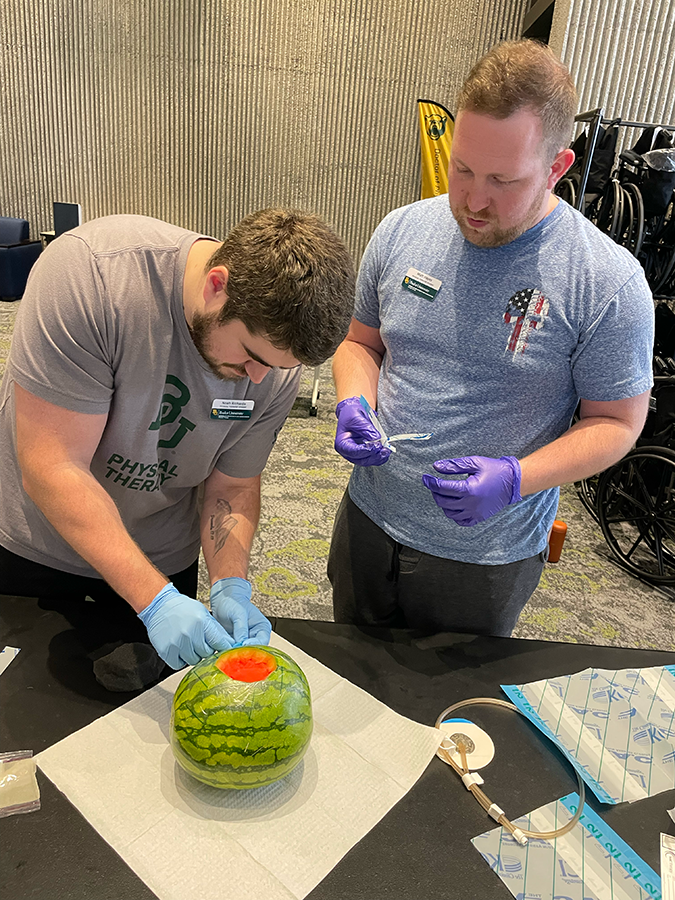
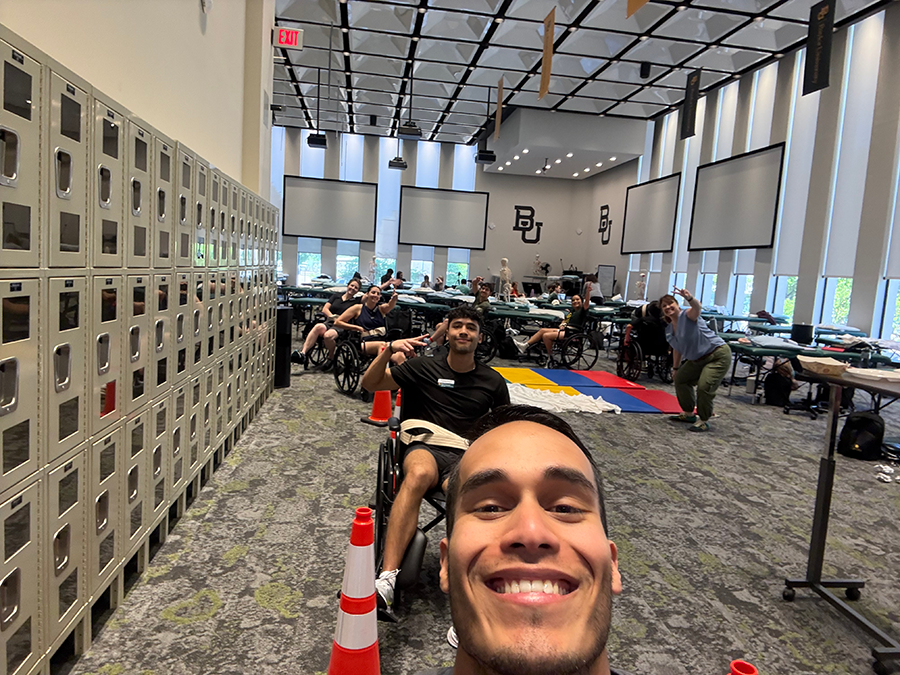
Explore a sample "day in the life" of a Baylor DPT student:
While the hybrid model offers students some flexibility in when and how they do their studying, Baylor DPT students are full-time students in every sense and will reach their fullest potential when committed to a structured, daily routine. Students can expect to put in up to 55 hours of work per week in class time, assignments and independent study.
“The virtual classroom is exciting and engaging. There's no shortage of questions to answer or interactive polls/quizzes. There are also breakout rooms for small group discussion.” —Dylan Lee (Class of 2025)
The didactic portion of the curriculum is divided into asynchronous and synchronous work:
- Asynchronous work is all done independently. It includes prerecorded lectures, readings, and independent assignments. Students typically focus on working through asynchronous materials Saturday-Monday in preparation for the week’s synchronous sessions.
Synchronous sessions are mandatory and take place live in our virtual classroom. During "synch" sessions, Baylor DPT faculty bring the materials studied independently to life and help students apply concepts through interactive polling, case studies, and vignettes. Students begin to learn and practice hands-on skills associated with the content. Synchronous sessions generally take place Monday through Thursday at 12:00pm and 2:00pm (CST), and last approximately 90 minutes each. Exams are typically on Fridays, unless it is a shortened week due to lab or holidays.
Sample Week in the Life of a Baylor DPT Student:
| Sunday | Monday | Tuesday | Wednesday | Thursday | Friday | Saturday | |
|---|---|---|---|---|---|---|---|
| Synchronous Schedule | 12:00pm, 2:00pm | 12:00pm, 2:00pm | 12:00pm, 2:00pm | 12:00pm, 2:00pm | 10:00am-1:00pm (Exams) | ||
| Daily Study* | 4-6 hours | 8 hours | 8 hours | 8 hours | 8 hours | 4-6 hours | 6-8 hours |
| Sleep | 8 hours | 8 hours | 8 hours | 8 hours | 8 hours | 8 hours | 8 hours |
| Personal Time | 10-12 hours | 6-8 hours | 6-8 hours | 6-8 hours | 6-8 hours | 10-12 hours | 6-8 hours |
*Estimated daily study hours account for both synchronous sessions and independent asynchronous work.
Can I continue to work while enrolled in the Baylor DPT program?
This is a common question! Baylor DPT students are cautioned not to hold outside employment while completing the program, as they are expected to give their time and attention to the full-time academic demands of the curriculum, travel requirements for onsite lab immersions, and the completion of three clinical rotations during the second half of the program.
While limited part-time employment (up to 8-12 hours/week) is maintained by a small percentage of students, we strongly encourage all students to avoid working during the first trimester to help facilitate a strong start in the program. After the first trimester, if students still want or need to work, they will be better able to create a work schedule that won't negatively impact their education. Full-time employment is not compatible with requirements for the program. Any student who is employed at any point in the program should notify their Faculty Coach and ensure they have alternate means for financial support should they need to end employment to provide more focus on their academic requirements.
Onsite labs for the Baylor DPT program are held every 6-8 weeks in Waco, Texas. The length of the lab depends on its content, but they are typically between 1-2 weeks long.
Download an academic calendar with more detailed information.
Onsite labs are dedicated to hands-on training. There are no lectures during lab immersions! Students can expect full days (8:00am - 5:30pm) in the lab, including weekends. Labs are led by dedicated and experienced faculty, including core Baylor DPT faculty members and clinical adjunct faculty who are experts in the field. During labs, students can anticipate a 10:1 student to faculty ratio, which means that each student will receive the focused attention they need to master their hands-on skills.
Sample Schedule for a Day at DPT 6540 Physical Therapy Examination Lab
| Time | Activity | Lead Faculty |
|---|---|---|
| 8:00-10:30am | Upper Extremity Manual Muscle Testing (continued from prior day) | Dr. Adams |
| 10:30-11:15am | Upper Extremity Flexibility | Dr. Adams |
| 11:15-11:45am | Pod Practice | Pod Faculty |
| 11:45am - 1:15pm | Lunch | |
| 1:15-1:30pm | Prep for Afternoon Sessions | Pod Faculty |
| 1:30-3:30pm | Gait with Assistive Device (Pods* 1-4) Wheelchair Mobility (Pods* 5-8) | Dr. Bachman, Dr. Gingles, Pod Faculty |
| 3:30-5:30pm | Gait with Assistive Device (Pods* 5-8) Wheelchair Mobility (Pods* 1-4) | Dr. Bachman, Dr. Gingles, Pod Faculty |
*At onsite labs, Baylor DPT students are divided into 'pods' to create a small-group atmosphere during instruction time.
“Working in smaller groups during lab helps to build rapport within our pod as well as with our pod lead. We're able to give each other constructive feedback when performing various techniques, and our pod leads are there to help demonstrate and support us as needed!” —Isabella Edano (Class of 2025)
Where do students from out of state stay when they come to Waco for labs?
Students are responsible for their own travel and lodging expenses during labs. Waco offers lots of hotel options, but most commuting students prefer to group up with classmates and share the cost of a short-term rental (i.e., Airbnb, Vrbo, etc.) in the area. This reduces overall expenses and gives students an opportunity to get to know each other and have fun outside of class.
Is there time for fun outside of lab?
When lab is finished each day, students have the opportunity to continue to practice and study with classmates in the Baylor DPT Student Center, or they can take some time to relax and enjoy the company of classmates. Some favorite after-hours activities include going to the SLC on Baylor’s main campus where students can play volleyball, basketball, work out, swim, etc. Students also love exploring downtown Waco, visiting one of the many coffee shops around town, or relaxing with down time at their Airbnb.
Baylor DPT students complete 31 weeks of full-time clinical education, comprised of (2) eight-week experiences and a 15-week experience. Here, students get to apply their knowledge and hands-on skills by helping patients under the supervision and guidance of a clinical instructor.
“The clinical rotation is really where it all comes together. I was learning so much in the classroom, but it felt like a lot of loose puzzle pieces in my brain. Now that I am in the clinic, those pieces are finally fitting together, and I am seeing the bigger picture. It really makes a difference working with real patients, gathering information about their real presentations, and treating them with real feedback and results! It’s so exciting!” —Amanda Correa (Class of 2025)
There is flexibility regarding the types of settings and geographic locations where clinical rotations take place, however, every student must complete at least one inpatient rotation and one outpatient rotation.
The Baylor DPT Student Support Team works with each student individually to match them to clinical sites where they can improve their skills and grow in their patient-client management capabilities. Each student is assigned a Program Manager who meets with them 1:1 to learn more about the student’s clinical interests. From there, the Student Support team works with clinical partners across the United States to place students.
Sample Schedule for a Day in the Clinic
| Time | Activity | Notes |
|---|---|---|
| 7:30-8:00am | Prep for Clinic Day | Outpatient Clinics: Prepare exercise plans, equipment Inpatient Facilities: Check schedule, review charts, patient rounds |
| 9:00-11:30am | Patient Care | Outpatient Clinics: Initial evaluations, reevaluations, patient treatments Inpatient Facilities: Patient treatments throughout facility, patient rooms |
| 11:30am-12:30pm | Finish Up Morning Schedule | Outpatient Clinics: Documentation, reorganize clinic and equipment Inpatient Facilities: Documentation, notes in patients' electronic records |
| 12:30-1:30pm | Lunch Break | During lunch, students may engage in a continuing education course, in-service, case-study presentation, or journal review with clinic/facility staff |
| 1:30-4:30pm | Patient Care | Outpatient Clinics: Reevaluations, patient treatments Inpatient Facilities: Group therapy, exercise class, patient treatments |
| 4:30-5:30pm | Finish Up Daily Schedule | Outpatient Clinics: Documentation, clean clinic and equipment; possibly work school sports clinic, see patients who come in after work Inpatient Facilities: Finish any post-op patient care, work with patients and family on discharge plans, document all in electronic records |
| Evening | DPT Coursework, Study Licensure Exam, Research Cases, Relax and Rest | During clinical rotations, students will continue Baylor coursework (1-2 classes per rotation). Courses are designed to accommodate clinic schedules. |
Will I be able to complete all of my clinical rotations in my hometown, or will I have to travel?
The Baylor DPT Student Support Team will work closely with each student to find out where they live, where they have family/friends around the country, and where they’d be willing to travel. While we will not sacrifice the quality of each student’s education for convenience, our team takes each student’s needs and preferences into account while determining the best learning pathway for them. This enables each one to be sent to top quality clinics where they will receive expert instruction.
Are Baylor DPT students enrolled in coursework during clinical rotations?
Yes, 1-2 courses run concurrently with clinical rotations and serve to reinforce and enhance what students are doing in the clinic.