Baylor Physical Therapy Faculty Pursue Innovation Through Internal Grant Awards
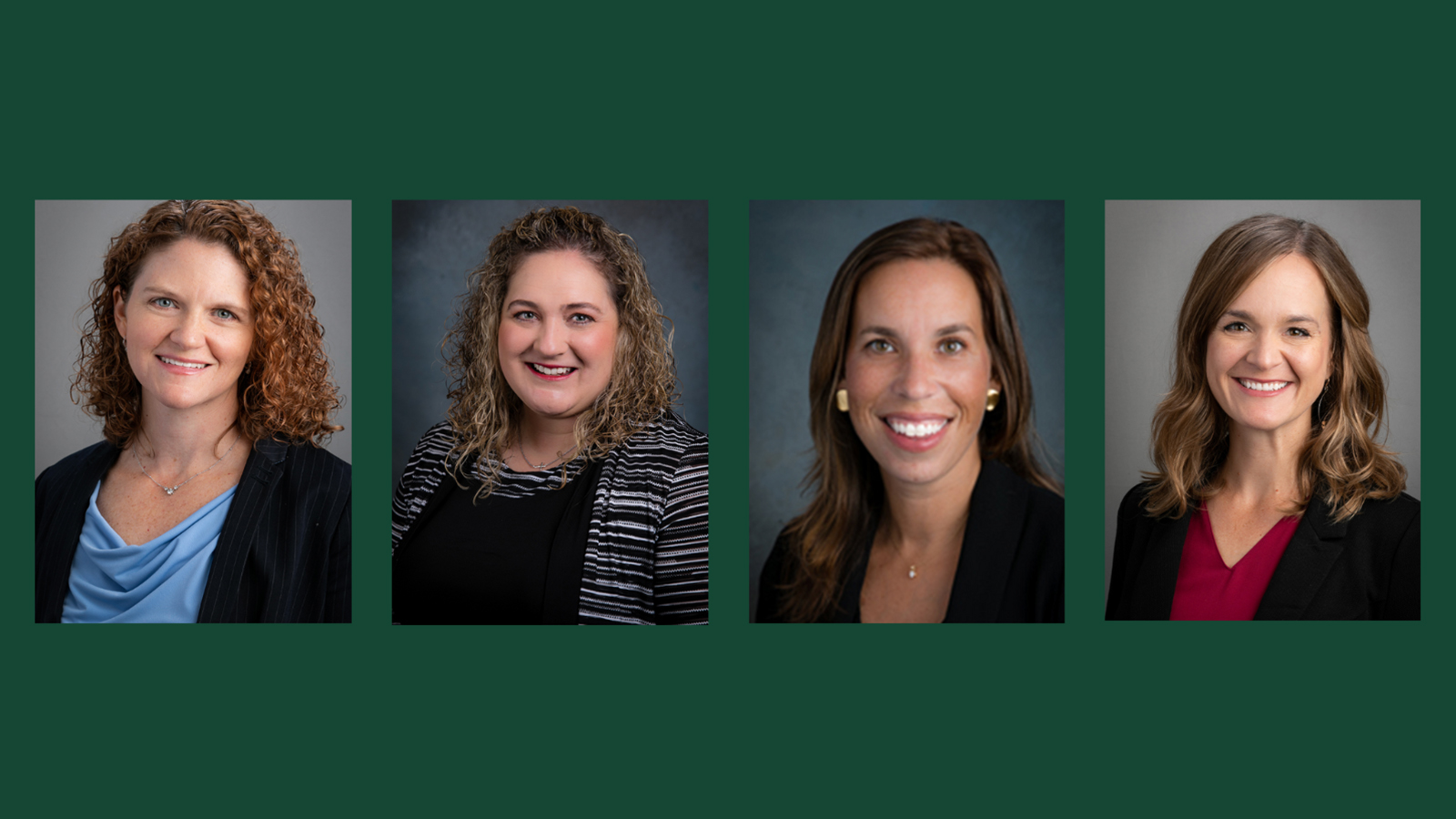
This past year, faculty for the Department of Physical Therapy in Baylor University’s Robbins College of Health and Human Sciences have continued their combined excellence in collaboration, research, and teaching, specifically through the receipt of internal grant awards.
The projects highlighted below received funding either through the Robbins College of Health and Human Sciences Research Award program, or through the Academy for Teaching and Learning’s University Teaching Exploration Grant.
The Robbins College Research Award is a new college-level funding program designed to support faculty who desire to submit external research and fellowship proposals. Funds are available up to $15,000. The competitive University Teaching Exploration Grant encourages faculty to engage in research projects related to teaching and learning in higher education and are awarded on two levels. Small grants, composed of funding up to $5,000, are awarded with an assurance that researchers will submit their findings to journals. Large grants, with funding up to $10,000, are awarded with an expectation the proposal will be submitted for additional, external funding.
CONNECTING THE WACO COMMUNITY TO PARKINSON’S RESEARCH
Boddy A, Smith CM. Physical Therapy: The Impact of High-Intensity Training Using a Non-Motorized Treadmill on Neuroplastic Changes in Individuals with Parkinson’s Disease. Robbins College Research Award. $14,829.84.
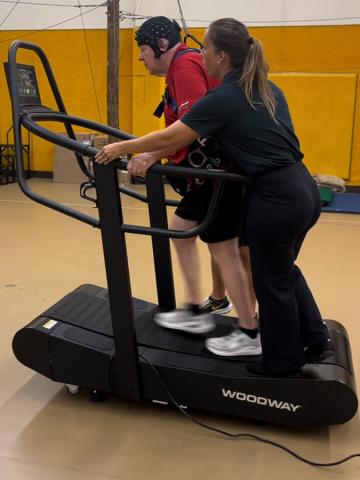
According to the Parkinson’s Foundation, nearly 90,000 people are diagnosed with Parkinson’s disease each year, significantly impacting their lives and their ease of movement. Clinical Associate Professor Anne Boddy, PT, DPT, PhD, is interested in how exercise and movement can improve quality of life for individuals with Parkinson’s disease. She enlisted the collaboration of Cory Smith, PhD, Assistant Professor for the Department of Health, Human Performance, and Recreation in Robbins College (HHPR), for the project.
Boddy has more than 15 years of clinical experience working with neurologically involved patients. Over the last three years, she and Melanie Lomaglio, PT, DPT, MSC, NCS launched the REBLOOM CENTER, a nonprofit with a mission to provide a welcoming community space where all people impacted by Parkinson’s disease can have continuous access to high quality resources. Recently, Boddy brought together her passion for working with individuals diagnosed with Parkinson’s disease with the Academy of NeurologicPhysical Therapy’s encouragement of intensity training, designing a study that has patients use a non-motorized treadmill to improve their nervous system’s self-generated movement.
“The exciting thing is that this is one of the first projects we’re actually doing purely on Baylor’s campus, which is new for our hybrid Doctor of Physical Therapy program,” Boddy said. “This is one of the first studies that we’ve been able to work with the Baylor and Waco communities at large. It’s truly exciting—we’re putting our name out there in the community, getting clinicians involved, and helping participants who are diagnosed with Parkinson’s disease in Waco.”
Boddy and Smith want to continue building upon their research, so they plan to apply for external grants with a particular interest in funding from the Parkinson’s Foundation or National Institutes of Health (NIH).
“The benefit of receiving funding from Robbins College through an internal grant is that it allows us to collect the pilot data, so we have enough knowledge and information to apply for additional funding. It really was necessary to get this pilot data,” Boddy said. “Robbins College was generous to help us get started.”
EFFECTS OF ACTIVITIES-BASED LOCOMOTOR TRAINING ON CHILDREN WITH CEREBRAL PALSY
Ardolino EA, Flores MB, Smith CM. Impact of an Activities-Based Locomotor Training Program Versus Traditional Physical Therapy in Children with Cerebral Palsy on Activity, Participation, and Neurophysiological Adaptations. Robbins College Research Award. $14,111.90.
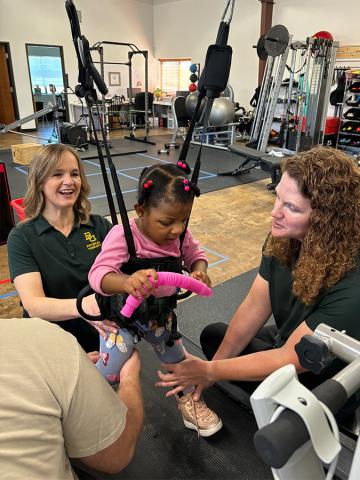
Children with cerebral palsy have a need for intense physical therapy, especially early on in their lives. Unfortunately, many children do not receive the necessary amount or the necessary intensity to improve their movement. Clinical Associate Professors Elizabeth Ardolino, PT, PhD, and Megan Flores, PT, PhD, alongside the Department of Health, Human Performance, and Recreation’s Assistant Professor Cory Smith, PhD, are working to fill this gap. Their study looks at a specific protocol as children participate in Activity-Based Locomotor Training (ABLT) to measure any possible changes in motor function and neurophysiology.
“During ABLT, the child comes to the clinic for three hours a day, five days a week, for three weeks,” Ardolino said. “We’re looking at what regions of the brain are active and how that activity changes in different parts of the brain after the therapy. Then, we monitor these children for an additional six weeks to see how changes in their brain and motor function compare during the three weeks of ABLT versus their typical care that they receive.”
Based on experience, Ardolino and Flores knew parents and children love the intensity protocol, but they wanted to understand why it was working and what exact changes were being made. They partnered with Smith because he has the technology and expertise to examine the changes at brain-level, whereas as physical therapists, Ardolino and Flores are focused on functional changes.
“By receiving seed money from Robbins College, we were able to collect this important pilot data,” Flores said. “This type of study also aligns with the mission and vision of the College, in terms of promoting rehabilitation and studying what the best methods are for rehabilitation across the lifespan.”
Ardolino and Flores hope to move their research forward, and they recently applied for a National Institutes of Health Research Enhancement Award (R15). They both feel this opportunity was only possible because of the investment from Robbins College.
“My passion is really just helping children and trying to find the best rehabilitation protocols for kids as possible,” Ardolino said. “So, I feel really fortunate that I have the opportunity to study different methods and figure out what’s going to help these kids the most. I’m really grateful to the College and the Department for supporting our research.”
STUDENT CONFIDENCE IN LAB IMMERSON
Bachman T, Ardolino EM, Flores M, Boddy A. The Impact of Patient Experiences During Lab Immersion on Student Confidence and Self-Efficacy in a Hybrid Physical Therapy Program. University Teaching Exploration Grant. $5,000.
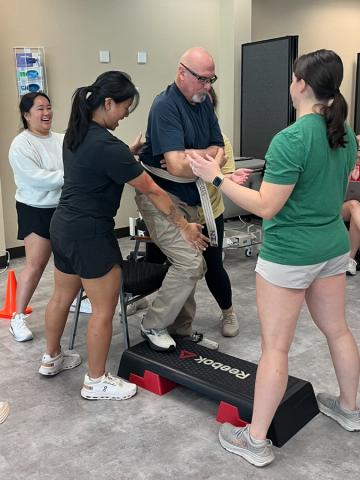
Teresa Bachman, PT, DPT, DHSc, Clinical Associate Professor and Graduate Program Director in the Department of Physical Therapy, believes that learning requires active immersion into experiences—and now, she has research findings beginning to back it up. Alongside Clinical Associate Professors Elizabeth Ardolino, PT, PhD, Megan Flores, PT, PhD, and Anne Boddy, PT, DPT, PhD, she is studying the possible impacts of experiential learning on students’ self-efficacy and self-confidence. Baylor Physical Therapy utilizes experiential learning to provide students an opportunity to interact with people from the local community to practice physical therapy techniques. The team is looking to understand benefits and limitations of inviting these volunteers or clients into classroom spaces.
“It’s active, experiential learning—being able to come in and experience something in a safe, controlled environment. This hopefully helps students feel fully prepared to move to the next step of their education,” Bachman said. “The results of this research will either provide us with evidence that we should continue this kind of experiential learning, or we may need to look at other pedagogical approaches. We want to be using whichever avenue best helps students gain experience prior to hitting their clinical affiliations.”
This mixed-methods project includes using survey components and focus groups to gain feedback. Students fill out assessment surveys before and during a learning experience, and once the learning experience is complete, the researchers receive quantitative data. at At the end of the learning experiences, small focus groups, with up to 10 participants, answer a set of questions that will help the team gain more subjective-type data.
Currently, the research team’s focus is analyzing the data they’ve collected. So far, the research is suggesting that students do indeed benefit from these types of experiential learning opportunities—so the team is also looking to refine and expand the lab immersion opportunities for Baylor Physical Therapy students.
“This is important research. We want to figure out how to be better teachers, and how to provide our students the best experience possible, so that they can become the best clinicians possible,” Ardolino said. “Learning which methods work, and which ones don’t work, will only help our department and our students become stronger.”
TEACHING OUTCOME MEASURES TO FUTURE PEDIATRIC PHYSICAL THERAPISTS
Flores MB. Standardized Pediatric Outcome Measures in Professional Physical Therapy Education. University Teaching Exploration Grant. $4,850.
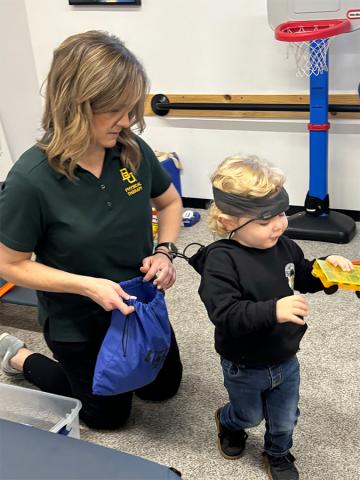
While at the American Physical Therapy Association’s Academy of Pediatric Physical Therapy Education Summit, Clinical Associate Professor Megan Flores, PT, PhD, discussed a discrepancy in pediatric physical therapy: outcome measures taught in physical therapist education programs versus outcome measures used by physical therapists in the clinic. With more than 100 tools used to assess effectiveness of a patient’s treatment to choose from, it’s important for educators to align with pediatric physical therapist practice.
Flores’s passion is a driving force for the research project. In collaboration with faculty from five universities, she has set out to survey which outcome measures are being taught in physical therapist programs and which ones are being used in clinical practice.
“I transitioned to practicing in pediatrics around 2010, and I never looked back because working with kids is just so fun,” Flores said. “In addition, teaching physical therapist practice to the next generation of professionals has become a passion of mine. I want to share that excitement of a rewarding career.”
The funding Flores received through her internal grant helped pay for incentives provided to participants in surveys and focus groups. Flores was also able to utilize funds for Baylor’s Statistics Consulting Services for assistance analyzing the complex survey.
The findings have kept her team busy. Recently, Flores presented the research at two national conferences and submitted a manuscript describing the study’s findings.